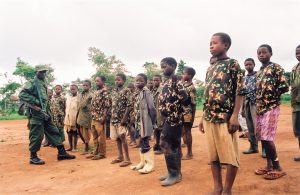
Child soldiers in the Democratic Republic of Congo https://www.amnestyusa.org/updates/ending-the-use-of-child-soldiers-one-step-forward/
When Israel is treated differently from other countries, it is fair to ask: why? In such cases we must at least consider the simplest and most obvious explanation: Israel is treated differently because it is the only Jewish state. By itself this certainly does not constitute incontrovertible proof of antisemitism, but unless another, better explanation for the double standard can be found, then one is justified in suspecting antisemitism. Researchers who study antisemitism have identified at least five different kinds of double standards that can be evidence of antisemitism, as was discussed in a previous post in this blog: The Five Double Standards of Left Antisemitism.
This post is the second in a series specifically looking at the “double standard of salience”, and, more specifically, at how this double standard is clearly at work in Bhikkhu Bodhi’s February, 2024 article: Israel’s Gaza Campaign Is the Gravest Moral Crisis of Our Time.
Below is an overview of five terrible humanitarian crises curently happening around the world. My point is not that one or more of these crises is worse or more “grave” than the situation in Gaza. Rather my point is that anyone who wishes to make the claim that Gaza is the gravest crisis of them all, and who wishes to be taken seriously, must necessarily make some effort to compare the situation in Gaza with these other clear examples of terrible injustice and human suffering.
• The Congo conflict
According to the Council for Foreign Relations (link):
Since 1996, conflict in eastern DRC has led to approximately six million deaths. The First Congo War (1996–1997) began in the wake of the 1994 Rwandan Genocide, during which ethnic Hutu extremists killed an estimated one million minority ethnic Tutsis and moderate Hutus in Rwanda (DRC’s neighbor to the east).
According to the International Holocaust Memorial Museum (link):
The Democratic Republic of Congo has experienced violent conflict since the start of the First Congo War in 1996–97. The Second Congo War (1998–2003), was the deadliest conflict since World War II. Today there is an ongoing political crisis as government power-sharing agreements are falling apart. The crisis is further complicated by multiple violent conflicts involving over one hundred armed groups, and multiple health epidemics including Ebola, COVID-19, and measles. The risk of a new mass killing in the Democratic Republic of Congo remains high, and our Early Warning Project has ranked the country in the top-10 highest-risk countries every year since the project began in 2014.
According to Al Jazeera (link):
Approximately six million people have been killed since 1996 and more than six million people remain internally displaced in eastern DRC [Democratic Republic of Congo].
The three quotes provided above only scratch the surface of the horrors of the ongoing Congo wars. The scale of this moral crisis is even greater when one understands that this conflict is in many ways an extension and continuation of the Rwandan genocide of 1994.
• The Syrian Civil War
According to Council for Foreign Relations (link):
What began as protests against President Assad’s regime in 2011 quickly escalated into a full-scale war between the Syrian government—backed by Russia and Iran—and anti-government rebel groups—backed by the United States and a rotating number of U.S. allies, including France, the United Kingdom, Italy, Saudi Arabia, Turkey, Jordan, and the United Arab Emirates (UAE). Three campaigns drive the conflict: coalition efforts to defeat the self-proclaimed Islamic State, violence between the Syrian government and opposition forces, and military operations against Syrian Kurds by Turkish forces…..
Meanwhile, the humanitarian situation in Syria remains dire, with 7 out of 10 Syrians requiring humanitarian assistance. According to estimates from the Syrian Observatory for Human Rights, more than 600,000 people have been killed since the start of the war. In its 2023 Global Appeal, the United Nations reported that more than 6.9 million are currently internally displaced, with more than 5.4 million living as refugees abroad. Many refugees have fled to Jordan and Lebanon, straining already weak infrastructures and limited resources. More than 3.4 million Syrians have fled to Turkey, and many have attempted to seek refuge in Europe.
According to researchers Aleksandar Kešeljević and Rok Spruk writing for the journal Empirical Economics (link):
According to the UNHRC more than 350,000 people have been killed, with 6.2 million displaced, including 2.5 million children within Syria. Furthermore, more than 700,000 Syrian nationals are estimated to have sought political asylum in Europe in 2015 and 2016 (Eurostat 2022; World Bank 2017a). As a result of the war, a pre-conflict population of over 20 million has declined to 18.2 million. Around 11.9 million people have been forcibly displaced within Syria and across its borders, out of which 5.7 million are refugees and 6.2 million are internally displaced. Moreover, a report by The Syrian Center for Policy Research (2015) shows that 80% of the population is now below the poverty line compared to 12.4% in 2007.
According to Al-Jazeera (link):
Twelve years ago, protesters dared to take to the streets of Syria to protest against the country’s government and its president, Bashar al-Assad.
The protests quickly took on a revolutionary nature, demanding the “fall of the regime”, but, after a violent response from the government, the uprising transformed into a war, dragging in several outside powers, displacing millions and killing hundreds of thousands.
Syria’s economy has deteriorated, with 90 percent of the population now living below the poverty line, according to the World Food Programme.
The United Nations estimated last year that more than 306,000 civilians have been killed – about 1.5 percent of the population – since March 2011 in the country.
The Syrian Observatory for Human Rights, a United Kingdom-based war monitor, estimates the total death toll to be about 610,000.
Much more detail about the ongoing humanitarian nightmare in Syria can be found at the links above. Its also noteworthy that the Syrian civil war has involved multiple cases of the use of chemical weapons, in at least one case leading to over a thousand deaths: Timeline of Syrian Chemical Weapons Activity, 2012-2022.
• Civil War in Sudan
According to the Council on Foreign Relations (link):
In April 2023, fighting between rival armed factions broke out in the Sudanese capital of Khartoum, raising fears of a return to full-scale civil war. The conflict is primarily a power struggle between the leaders of the Sudanese Armed Forces (SAF) and a powerful paramilitary group known as the Rapid Support Forces (RSF). The two groups, led by General Abdel Fattah al-Burhan and Mohamed Hamdan “Hemedti” Dagalo, respectively, are battling one another for control of the state and its resources. As the conflict deepens, humanitarian conditions are declining, and the promise of a long-awaited democratic transition diminishes…..
Several NGOs, including Human Rights Watch, have documented evidence of numerous mass atrocities committed throughout the conflict, prompting accusations of ethnic cleansing and war crimes. In early November, RSF forces and allied militias killed more than 800 people in a multi-day rampage in Ardamata, a town in western Darfur. This recent attack reflects a new surge of ethnically driven killings targeting the Masalit in West Darfur. The UN High Commissioner for Refugees (UNCHR) Filippo Grandi warned that current violence is emblematic of the U.S.-recognized genocide in Darfur that killed an estimated 300,000 people between 2003 and 2005. A statement made by the UN in January indicated that between 10,000 and 15,000 people had been killed last year due to ethnic violence by the RSF and its allies in West Darfur. In April 2024, U.S. Ambassador to the United Nations Linda Thomas-Greenfield highlighted evidence indicating that women and girls as young as fourteen years old have been victims of sexual violence perpetrated by the RSF.
According to Deutsche Welle (link):
The list of wartime atrocities in Sudan is long and getting longer.
A maternity hospital bombed, causing the roof to fall onto babies inside. Refugee camps shelled, mass executions, streets filled with corpses, aid blocked, systematic sexual abuse and other war crimes: since the civil war started a year ago in the northeast African country, an estimated 16,000 people have been killed.
Sudan’s war has also created the world’s worst displacement crisis, with just under 10 million people forced to move to find safety. Last week, the United Nation’s International Organization for Migration reported that of the millions of Sudanese displaced, 70% were “now trying to survive in places that are at risk of famine.”
…. Why is no attention being paid to Sudan?In mid-April, Melissa Fleming, the under-secretary-general for global communications at the UN, wrote a self-published op-ed in which she explored this question.
One reason for the lack of attention might be what is known as “psychic numbing,” Fleming wrote. “The term … refers to the sad reality that people feel more apathetic towards a tragedy as the number of victims increases.”
Other crises happening simultaneously can also have a numbing effect, she added — everything from climate change to the conflict in Gaza and the Ukraine war.
According to Al-Jazeera (link):
The war has spread across several regions of the country and led to the collapse of infrastructural systems including healthcare and sanitation services, as well as causing thousands of deaths and the displacement of millions. The precise number of people killed is very unclear, with reports varying from one source to another.
As of April 2024, nearly 16,000 people, including military personnel, had been killed, according to the Armed Conflict Location & Event Data Project (ACLED). However, ACLED and experts have said those numbers are a significant undercount, due to the difficulty in collecting accurate, real-time data during a conflict of this nature.
A report by the UN refugee agency, UNHCR, in October stated that nearly 4,000 civilians had been killed and 8,400 injured in Darfur alone, between April 15 and the end of August. According to a UN report seen by Reuters in January, between 10,000 and 15,000 people had been killed in just one city – El Geneina, in Sudan’s West Darfur region – last year….
Sudan is currently “experiencing a humanitarian crisis of epic proportions”, according to the UN. The country is grappling with acute shortages of essential items such as food, clean water, medicines and fuel. Prices have skyrocketed as a result of the scarcity.Approximately half of Sudan’s 49 million people are in need of humanitarian assistance, the UN says. Nearly 18 million are also facing “catastrophe levels of food insecurity”, especially in parts of West Darfur, Khartoum, and among the IDPs.
Aid groups are struggling to provide humanitarian assistance because of blocked access, security risks and other logistical challenges. In March, the UN was able to distribute food aid to West Darfur for the first time in months.
As noted in the Al-Jazeera quote above, “The precise number of people killed is very unclear, with reports varying from one source to another.” In February (2024), US Special Envoy for Sudan Tom Perriello told the Senate Foreign Relations Committee (link): “We literally don’t know how many people have died, possibly to a factor of 10 or 15. The number was mentioned earlier 15 to 30,000. Some think it’s at 150,000.”
• War in Yemen
Council on Foreign Relations (link):
Yemen’s civil war began in 2014 when Houthi insurgents—Shiite rebels with links to Iran and a history of rising up against the Sunni government—took control of Yemen’s capital and largest city, Sanaa, demanding lower fuel prices and a new government. Following failed negotiations, the rebels seized the presidential palace in January 2015, leading President Abd Rabbu Mansour Hadi and his government to resign. Beginning in March 2015, a coalition of Gulf states led by Saudi Arabia launched a campaign of economic isolation and air strikes against the Houthi insurgents, with U.S. logistical and intelligence support….
Meanwhile, the conflict has taken a heavy toll on Yemeni civilians, making Yemen the world’s worst humanitarian crisis. The UN estimates that 60 percent of the estimated 377,000 deaths in Yemen between 2015 and the beginning of 2022 were the result of indirect causes like food insecurity and lack of accessible health services. Two-thirds of the population, or 21.6 million Yemenis, remain in dire need of assistance. Five million are at risk of famine, and a cholera outbreak has affected over one million people. All sides of the conflict are reported to have violated human rights and international humanitarian law.
Kurdistan
United Nations World Food Program (link):
Eight years of war in Yemen have taken a devastating toll on civilians. The conflict has claimed over 377,000 lives and displaced 4.5 million people. 21 million people need humanitarian assistance, and 17 million people in Yemen are extremely hungry .
The conflict has destroyed the country’s infrastructure, including major roads and airports. The collapse of the economy, high cost of goods and devalued currency make it very difficult for people to access basic necessities.
According to Ahmed Nagi, writing for Foreign Affairs (link, but note that you have to provide your email to read the whole article):
The eight-year civil war in Yemen has created what has been called the world’s worst manmade humanitarian crisis. Hundreds of thousands of Yemenis have been killed and some four million people displaced. According to the United Nations, 21.6 million people in the country require humanitarian assistance and 80 percent of the population struggles to put food on the table. Given the extent of the catastrophe, it is perhaps no surprise that observers rejoiced when the Saudi ambassador to Yemen, Mohammed Al-Jaber, shook hands with leaders of the Houthi rebel group, which is allied with Iran, in April. It appeared to be a breakthrough in a devastating, unending conflict.
According to Save the Children, by 2022 as many as 85,000 children may have starved to death in Yemen due to the civil war (link). And here is a link to a Timeline of the Yemen Crisis from The Arab Center of Washington DC.
• Kurdistan
The “Kurdish Problem” is certainly one of most neglected human rights issues in the world. If Kurdistan were a soverign nation, its population would be about 30 million, larger than Syria (22M), and almost twice the size of Jordan (11M) and Lebanon (5.5M) combined. It would also be more populous than all the nations of Scandinavia put together (28M). But instead, the Kurdish people are dispersed among the states of Turkey, Syria, Iran, Iraq, and Armenia. When the modern borders of the Middle East were drawn, the Kurds were simply invisible.
In Iraq a separate Kurdish autonomous region is recognized by the Iraqi central government, and one must admit that this is actually a positive result of the 2003 US invasion of Iraq. In Syria the defacto autonomous Kurdish region of Rojava exists in spite of efforts by the Assad government to assert control over the region (and here again, the United States has played small, and highly complex, role in supporting the Syrian Kurds). In Turkey, where Kurds constitue over 20% of the population, repression of the Kurds is fierce and ongoing.
Prior to the overthrow of Saddam, the violent persecution of the Kurdish people by the Iraqi government knew no limits. It was against the Kurds that Saddam used a combination of mustard gas and nerve agents, killing at least 3,000, probably more. This was the largest ever incident in human history of using chemical weapons against a civilian population. In all Saddam killed well over 100,000 Kurds, possibly as many as 200,000. Nearly all of them were civilians.
One of the most important aspects of modern Kurdish history is the heroic role (and this is not hyperbole) that the Kurds played in downfall of ISIS. For a while people were actually paying attention to and giving meaningful support to the Kurds, precisely because they were on the front lines of fighting ISIS. But as soon as ISIS was vanquished, this attention and support mostly vanished.
Here are some online sources for learning more about the Kurds and their ongoing struggles against the governments of Turkey, Iran, and Syria, as well as the remaining remnants of ISIS and other Islamist extremist groups:
-
- 1920 – 2022: The Kurds Long Struggle with Statelessness (The Council of Foreign Relations)
- The Kurdish Project
- Iraqi Kurdistan 20 Years After (International Crisis Group, April 2023)
- The Kurdish Genocide Unrecognized Nations and Peoples’ Organization,
- Turkey launches air attacks against Kurdish rebels in Iraq and Syria (Al-Jazeera Jan 2024)
- Survivors of the Anfal Kurdish genocide long for closure (Al-Jazeera, April 2021)
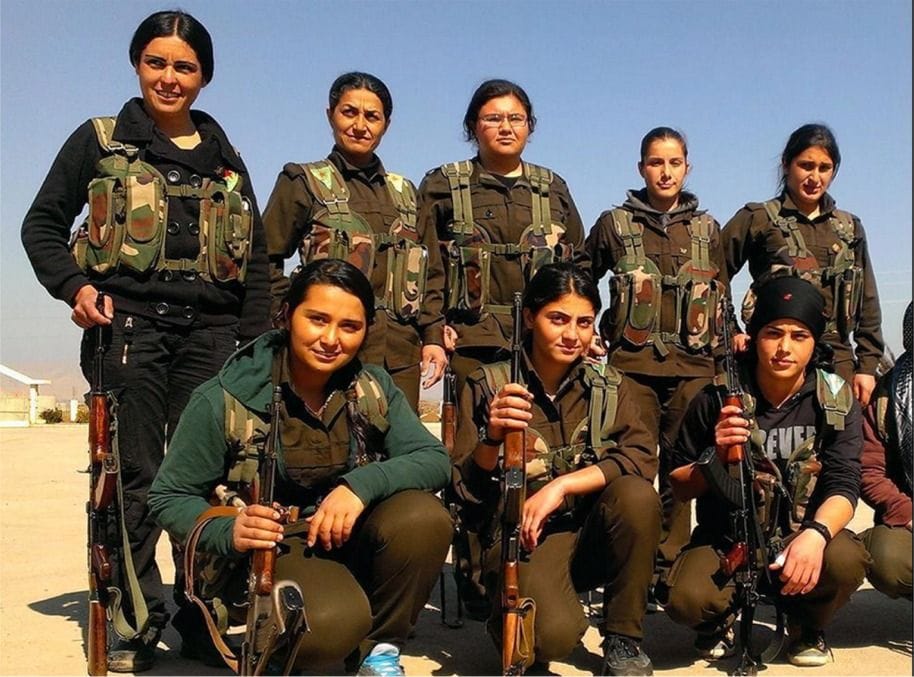
Kurdish women fighters in Rojava https://thekurdishproject.org/history-and-culture/kurdish-democracy/rojava-democracy/
 The Tikvah Fund is offering a free online course taught by Einat Wilf: “Zionism and Anti-Zionism: The History of Two Opposing Ideas A new online course with Dr. Einat Wilf and Zoé Tara Zeigherman”.



 The melancholy and disgraceful fact being established that, in these closing decades of the nineteenth century, the long-suffering Jew is still universally exposed to injustice, proportioned to the barbarity of the nation that surrounds him, from the indescribable atrocities of the Russian mobs, through every degree of refined insult to petty mortifications, the inevitable result has been to arouse most thinking Jews the necessity of a vigrous and concerted action of defense. They have long enough practiced to no purpose the doctrine which Christendom has been content to preach, and which was inculcated by one of their own race, when the right cheek was smitten to turn the left. They have proved themselves willing and able to assimilate with whatever people and endure every climatic influence. But blind intolerance and ignorance are now forcibly driving them into that position which they have so long hesitated to assume. They must establish an independent nationality …. I am fully persuaded that all suggested solutions other than this of the Jewish problem are but temporary palliatives.
 The name Emma Lazarus might not ring a bell, but you are certainly familiar with her work. She wrote the poem “The New Colossus”, which is engraved on the base of the Statue of Liberty. Lazarus published her first poetry collection when whe was just 18 years old (some of the poems had been written when she was just 14). In fact, Lazarus, who died in 1887 at the age of 38, would not live long enough to witness the the first World Zionist Congress, which took place in Basel, Switzerland, in August, 1897. That historic gathering was a direct result of the growing realization so clearly expressed by Lazarus that “all suggested solutions other than this [Zionism] of the Jewish problem are but temporary palliatives.”