
Just Another Zionist Buddhist Wordpress Site

Category: antisemitism

A Little Light Reading

This post is another list of things to read, specifically books. Reading is good. Ignorance is bad. I love books.

For each book I provide a relevant link (to a review, an article about the author, etc). I am not providing direct links to the books themselves, which you can easily locate yourself with the author and title.

The books alternate between Zionist authors (odd numbered) and anti-Zionist authors (even numbered). If you are a Zionist, you really should know what the anti-Zionists are saying, and vice-versa.

        1. Adi Schwartz, Einat Wilf  The War of Return: How Western Indulgence of the Palestinian Dream has Obstructed the Path to Peace
          book review by Alex Ryvchin at fathomjournal.org
        2. Ilan Pappé The Ethnic Cleansing of Palestine
          My Israeli Friends: This is Why I Support Palestinians article by Ilan Pappé at palestinechronicle.com
        3. Susie Linfield The Lions’ Den: Zionism and the Left from Hannah Arendt to Noam Chomsky
          The Return of the Progressive Atrocity quillette.com article by Susie Linfield

        4. Maxime Rodinson Israel: A Colonial Settler State?
          Maxime Rodinson Was a Revolutionary Historian of the Muslim World A bio from a leftist anti-Zionist perspective
        5. Benny Morris 1948: A History of the First Arab-Israeli War
          Israeli Historian Benny Morris Addresses the War Against Hamas algemeiner.com Feb 15, 2024
        6. David Cronin Balfour’s Shadow: A Century of British Support for Zionism and Israel
          David Cronin’s Blog hosted at electronicintifada.net
        7. Daniel Gordis Israel: A Concise History
          A review of Gordis’ book by Philip K. Jason at jewishbookcouncil.org
        8. Rashid Khalidi

        9. Ghassan Kanafani Selected Political Writings
          The 1936–39 Revolt in Palestine – Ghassan Kanafani
        10. Anita Shapira Israel: A History
          Indispensable Man Anita Shapira on David Ben-Gurion (at jewishreviewofbooks.com)
        11. Rashid Khalidi  The Hundred Years War on Palestine
          Rashid Khalidi, Edward Said Professor of Modern Arab Studies his professional website at (can you guess??) Columbia University
        12. Cary Nelson Dreams Deferred: A Concise Guide to the Israeli-Palestinian Conflict and the Movement to Boycott Israel
          ‘We can have a debate about whether Hamas did the right thing’: Judith Butler’s Moral Relativism by Cary Nelson at fathomjournal.org
        13. Ben White Israeli Apartheid: A Beginner’s Guide
          Why Israel is an apartheid state  by Ben White at palestinecampaign.org
        14. Matthias Küntzel Nazis, Islamic Antisemitism and the Middle East
          1967: Nasser’s Antisemitic War Against Israel fathomjournal.org interview with Matthias Küntzel
        15. Anita Shapira

          Edward Said Blaming the Victims: Spurious Scholarship and the Palestinian Question
          Edward Said Showed Intellectuals How to Bring Politics to Their Work jacobin.com article by Conor McCarthy

        16. Haim Hillel Ben-Sasson (ed.) A History of the Jewish People
          Shmuel Ettinger at “My Jewish Learning”  four excerpts from Shmuel Ettinger’s contribution to A History of the Jewish People
        17. Albert Hourani A History of the Arab Peoples
          The Case Against a Jewish State: Albert Hourani’s statement to the Anglo-American Committee of Enquiry of 1946

What She Said (Einat Wilf)

Zionism is a progressive cause that had the misfortune of success. As such, it is maligned for its very success in self-transforming victims into sovereigns, now cast as “privilege”. But isn’t the very goal of “progress” in progressive to move away from victim to self-possessed?

A Guide for the Perplexed (Distinguishing antisemitism from legitimate criticism of Israel and Zionism, Part Two)

Hajj Amin al-Husseini (left), Heinrich Himmler (right)

“For the most part, postwar Germany has repudiated and dissociated itself from its Nazi past and has made a serious commitment to the writing of honest history. In contrast, the Arab world has failed to take this important step.”

This post is a collection of resources which provide background on this question: How can we distinguish antisemitism from legitimate criticism of Israel and Zionism? The quote above is from the main article, by Joel Fishman, in the Fall, 2014, issue of the Jewish Political Studies Review, linked to below (# 11).

Please note that half of the items listed below (the odd numbers) are from pro-Zionist sources that generally agree with the definition of antisemitism from the International Holocaust Remembrance Alliance (IHRA). That definition is also supported by the Anti-Defamation League, the World Jewish Congress, etc., and it is found in the first item on the list below. The very next item after that is an Al Jazeera article attacking the defintion. Which brings me to the other half of the list (the even numbers), which are all from sources that are anti-Zionist, and who vehemently reject the IHRA definition (according to which they are all proponents of antisemitism, not to put too fine a point on it). The only exception is the last item (# 13), which is an 80 minute long debate between articulate proponents of both sides of the issue.

  1. Working Definition of Antisemitism International Holocaust Remembrance Alliance
  2. An Al Jazeera “Explainer” on the IHRA definition of antisemitism
  3. The 1948 Arab war against Israel: An aftershock of World War II? by Matthias Kuntzel, fathomjournal.org, June, 2023
  4. Criticism of Israel’s war and occupation is not anti-Semitism Maximilian Hess, Al Jazeera, March 13, 2024
  5. 3D Test of Anti-Semitism: Demonization, Double Standards, Delegitimization by Natan Sharansky, Jewish Political Studies Review 16:3-4 (Fall 2004)
  6. Targeting Free Speech & Redefining Antisemitism: How Pro-Israel Actors Are Using US Laws to Attack Palestinian Activism & Solidarity Lara Friedman, University of the Pacific Law Review, July, 2023
  7. About the IHRA Working Definition of Antisemitism Anti-Defamation League
  8. Distorted Definition: Redefining Antisemitism to Silence Advocacy for Palestinian Rights palestinelegal.org
  9. The BDS Pound of Flesh Einat Wilf, tabletmag.com, May 10, 2022
  10. Israel, Palestine, BDS, and the right to boycott in the US Al Jazeera (youtube video),
  11. The Historical Problem of Haj Amin al-Husseini, “Grand Mufti” of Jerusalem Jewish Political Studies Review Volume 26, Numbers 3–4 (Fall, 2014)
  12. Blame it on the mufti Khaled Diab, Al Jazeera (opinion), Oct 22, 2105
  13. Anti-Zionism is Anti-Semitism intelligencesquared.com, a conversation with Melanie Phillips, Einat Wilf, Mehdi Hasan, and Ilan Pappé, chaired by Carrie Gracie

Dinstinguishing antisemitism from legitimate criticism of Israel and Zionism (Part One)

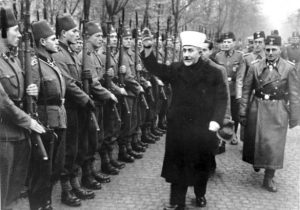
Hajj Amin al-Husseini reviewing Bosnian Waffen SS Volunteers

All criticism of Israel is not necessarily antisemitic. Nor is all criticism of Zionism automatically antisemitic. So how does one distinguish between legitimate criticism and antisemitism?

This is not a new question. Going back to 1948 (and even before) explicit antisemitism has been inextricably linked to the Arab rejection of the very idea, let alone the reality, of a Jewish state in Palestine. This is not in any way an exaggeration or a mischaracterization.

Hajj Amin al-Husseini, who has been described by Edward Said as “Palestine’s national leader”, stated in an interview in March of 1948 that Arabs “would continue fighting until the Zionists were annihilated and the whole of Palestine became a purely Arab state.” At that time al-Husseini was the chairperson of the Arab Higher Committee (AHC), which, again according to Edward Said, “represented the Palestinian Arab national consensus, had the backing of the Palestinian political parties that functioned in Palestine, and was recognized in some form by Arab governments as the voice of the Palestinian people.” [see Said’s book “Blaming the Victims”, Verso, 1988, p. 248].

Edward Said has also said of al-Husseini and the Arab Higher Committee (AHC), that they “kept Palestinian hopes alive” after the catastrophic defeat of the Arab armies who fought ineptly and unsuccessfully to prevent the formation of the state of Israel in 1948. And just what was it that the Palestinians were “hoping” for? In a 1974 interview, al-Husseini stated “There is no room for peaceful coexistence with our enemies. The only solution is the liquidation of the foreign conquest in Palestine within its natural frontiers and the establishment of a national Palestinian state on the basis of its Muslim and Christian inhabitants and its Jewish [inhabitants] who lived here before the British conquest in 1917 and their descendants.”

Let’s be clear about what “Palestine’s national leader” is stating above: he is advocating for the complete eradication of the state of Israel and the expulsion of all Jews, with the possible exception of those who were in Palestine prior to 1917 and their descendants. [For the quotes from al-Husseini, see  1948: A History of the First Arab-Israeli War by Benny Morris, Yale, 2008, pp. 408-409.]

One thing that we must learn from al-Husseini is that it is perfectly reasonable to suspect antisemitism whenever one hears the chant “From the River to the Sea!”, or even when we hear of people being “in solidarity with Palestine”. The Arab rejection of Israel and Zionism has always been rooted in antisemitism.

To learn more:

Photo of Rashida Tlaib speaking at a conference where she shared the platform with multiple members and supporters of a Palestinian terrorist group: The People’s Front for the Liberation of Palestine, a group dedicated to the violent eradication of the state of Israel. From the Free Press article linked to above.

Welcome to Buddhists Against Antisemitism

Sticky post

Buddhists should oppose antisemitism. Duh. But what is antisemitism?
The following is from the “Working definition of antisemitism” by the International Holocaust Remembrance Alliance:

Contemporary examples of antisemitism in public life, the media, schools, the workplace, and in the religious sphere could, taking into account the overall context, include, but are not limited to:

  1. Calling for, aiding, or justifying the killing or harming of Jews in the name of a radical ideology or an extremist view of religion.
  2. Making mendacious, dehumanizing, demonizing, or stereotypical allegations about Jews as such or the power of Jews as collective — such as, especially but not exclusively, the myth about a world Jewish conspiracy or of Jews controlling the media, economy, government or other societal institutions.
  3. Accusing Jews as a people of being responsible for real or imagined wrongdoing committed by a single Jewish person or group, or even for acts committed by non-Jews.
  4. Denying the fact, scope, mechanisms (e.g. gas chambers) or intentionality of the genocide of the Jewish people at the hands of National Socialist Germany and its supporters and accomplices during World War II (the Holocaust).
  5. Accusing the Jews as a people, or Israel as a state, of inventing or exaggerating the Holocaust.
  6. Accusing Jewish citizens of being more loyal to Israel, or to the alleged priorities of Jews worldwide, than to the interests of their own nations.
  7. Denying the Jewish people their right to self-determination, e.g., by claiming that the existence of a State of Israel is a racist endeavor.
  8. Applying double standards by requiring of Israel behavior not expected or demanded of any other democratic nation.
  9. Using the symbols and images associated with classic antisemitism (e.g., claims of Jews killing Jesus or blood libel) to characterize Israel or Israelis.
  10. Drawing comparisons of contemporary Israeli policy to that of the Nazis.
  11. Holding Jews collectively responsible for actions of the state of Israel.

Page 7 of 7

Powered by WordPress & Theme by Anders Norén